AI voice cloning recreates a specific person's voice from a short audio sample, then uses it to speak any text. Here's how it works, what it's for, and how to try it.
What Is AI Voice Cloning?
AI voice cloning is technology that recreates a specific person's voice from a short audio sample, then generates new speech in that voice from any text you type.
In other words, you give it a few seconds of someone speaking, and it can then "say" sentences that person never actually recorded — in their tone, accent, and rhythm.
Modern tools can do this from as little as a 15-second sample. That's the leap that turned voice cloning from a studio project into something you can do in a browser tab.
Ten years ago, convincingly faking a voice meant a recording studio, a gifted impressionist, or hours of manual audio editing. Today a neural network simply learns the statistical pattern of a voice and reproduces it on demand.
That shift — from manual imitation to a learned model, sometimes called a digital voice twin — is exactly what the "AI" in AI voice cloning refers to. And it's why the technology went mainstream so quickly in 2025 and 2026.
In one sentence
Voice cloning copies a voice; a voice generator produces speech. Cloning is the part that makes the output sound like you specifically, not a generic narrator.
What a clone actually copies
A good clone captures more than pitch. It models the fingerprint of a voice:
- Timbre — the unique "color" of the voice.
- Accent and pronunciation — how you shape words.
- Cadence — your rhythm, pauses, and emphasis.
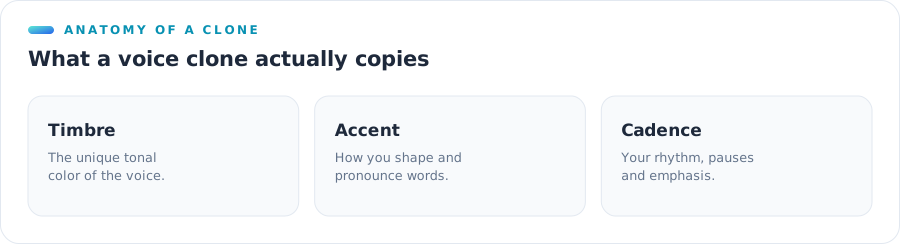
What a voice clone copies: timbre, accent, cadence
What it does not copy is a specific recording. A clone is a new voice model, not a stolen audio file — a distinction that matters both technically and legally.
A useful analogy: a clone is like a musician learning to play in someone's style, not a photocopy of their sheet music. It captures the "how" of a voice, then applies it to words that were never originally spoken.
Voice cloning vs an AI voice generator
People use these terms interchangeably, but they're slightly different. An AI voice generator turns text into speech using any voice — often stock voices. Voice cloning is what lets that generator use a specific custom voice you created.
Simple way to remember it
Cloning builds the voice; generating uses the voice. Most tools, including AnyVoice, do both — you clone once, then generate as much speech as you want from that single voice, whenever you need it.
How Does AI Voice Cloning Work?
Under the hood it's deep learning, but the workflow is four simple steps.
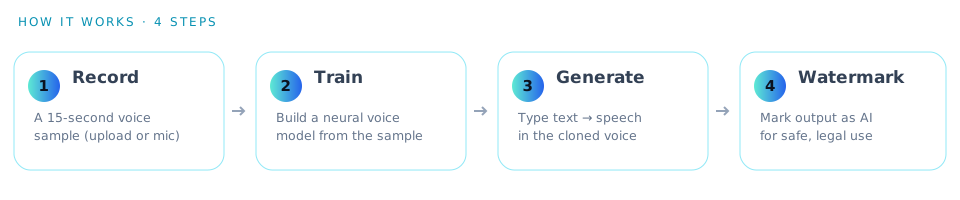
How AI voice cloning works, end to end
Step 1: Record a sample
You provide a short, clean recording — upload a file or record straight from your mic. Clean audio (no music, low noise) matters more than length.
Fifteen to thirty seconds is plenty. What the model wants is a representative clip: you, speaking normally, with no one talking over you.
Step 2: Train the voice model
The system analyzes the sample and builds a voice model — a mathematical representation of what makes that voice unique. With modern "zero-shot" models, this takes seconds, not hours.
You don't manage any of this — it happens on the server. The result is a private voice you can reuse as often as you like.
Step 3: Generate speech from text
Now you type. The model reads your text and produces audio in the cloned voice, usually with controls for language, speed, and emotion.
Because the voice is now a model rather than a recording, you can generate an hour of new audio as easily as a single sentence.
Step 4: Watermark and safeguards
Responsible tools mark the output as AI-generated and record that you had the right to clone the voice. This step is increasingly required by law — more on that below.
Zero-shot vs fine-tuned models
Two techniques sit behind step 2. Zero-shot models generalize from a single short sample almost instantly — that's what makes 15-second cloning possible. Fine-tuned models train longer on more audio to squeeze out extra fidelity.
Instant consumer tools lean zero-shot; studios lean fine-tuned. The gap between them shrinks every year.
Want the deeper technical version? See our full guide on how AI voice cloning works.
Instant vs Professional Voice Cloning
Not all cloning is the same. There are two broad tiers, and knowing which you need saves time and money.
Instant cloning (zero-shot)
Instant cloning builds a usable voice from a 15–30 second sample, almost immediately. It's perfect for quick content, prototyping, and personal projects.
It's what most people mean by "AI voice cloning" today, and it's the default in browser-based tools like AnyVoice.
Professional cloning (fine-tuned)
Professional cloning uses several minutes to hours of studio audio to squeeze out maximum fidelity and emotional range. It's what audiobook publishers and studios use.
It costs more and takes longer to set up, but it captures the fine emotional detail that broadcast and publishing work sometimes demand.
Which one do you need?
For most creators, instant cloning is more than enough — and the quality gap has narrowed sharply in 2026. Reach for professional cloning only when you need broadcast-grade nuance.
Here's the honest reality: for narration, video voiceover, and most business use, instant cloning is now good enough that listeners rarely notice. The remaining gap shows up in long-form emotional performance — think a dramatic novel audiobook — where a fine-tuned model still has the edge.
Voice Cloning vs Text-to-Speech vs Dubbing
Three related terms cause a lot of confusion. Here's how they differ.
| Feature | Text-to-Speech | Voice Cloning | AI Dubbing |
|---|---|---|---|
| Voice used | Stock voices | Your custom voice | Cloned or stock |
| Input | Text | Text | Existing video/audio |
| Keeps your identity? | No | Yes | Often yes |
| Main use | Narration | Personal voice | Translation |
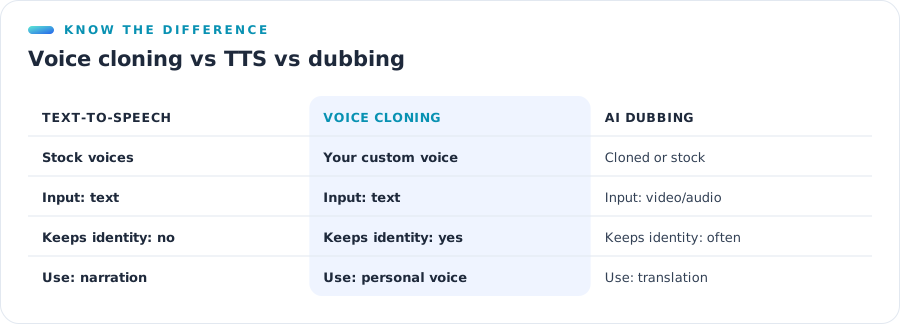
Voice cloning vs text-to-speech vs dubbing
Text-to-speech (TTS)
TTS turns text into speech using a library of ready-made voices. Great when you don't care whose voice it is.
Voice cloning
Cloning adds identity. The output sounds like a specific person because the model was built from their voice — so it's the right choice whenever who is speaking matters as much as what they say.
AI dubbing
Dubbing takes existing audio or video and re-voices it — often in another language — frequently using a clone so the speaker still sounds like themselves.
Which one should you use?
Pick TTS when the voice doesn't need to be anyone in particular. Pick voice cloning when it must sound like a specific person. Pick AI dubbing when you're translating existing footage and want to keep the original speaker's identity intact.
What Can You Use AI Voice Cloning For?
Once a voice is cloned, it becomes a reusable asset. Here's where people put it to work.
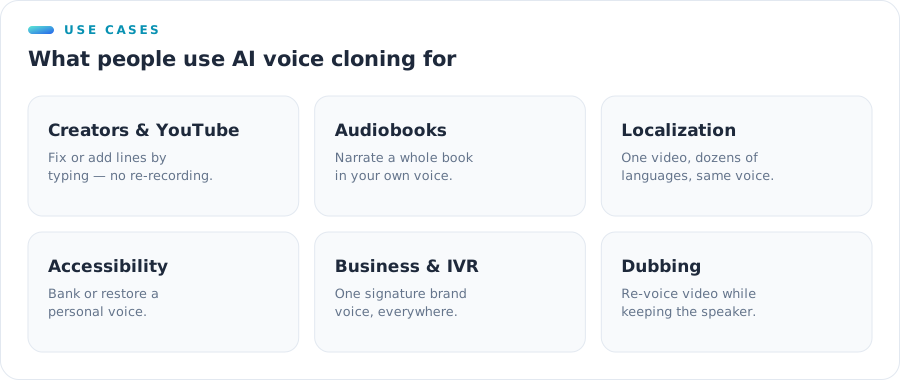
Popular AI voice cloning use cases
Content creators and YouTubers
Record once, then fix mistakes or add lines by typing — no re-recording. Creators also clone their voice to scale output without burning out their vocal cords. A YouTuber can fix a mispronounced name in seconds instead of re-recording a whole segment.
Audiobooks and narration
Authors narrate entire books in their own voice without weeks in a booth, and update chapters by editing text. A self-published author can release an audiobook the same week as the ebook, at a fraction of studio cost.
Localization and dubbing
Turn one video into dozens of languages while keeping the original speaker's voice — a huge unlock for going global. A single creator can now reach audiences in Spanish, Hindi, and Japanese without hiring a single voice actor.
Accessibility and personal voice
People at risk of losing their voice — for example ahead of certain surgeries or diagnoses — can bank it in advance. Others build a personal voice for assistive reading apps. This is voice cloning at its most human, and it's a use case with real dignity behind it.
Business and customer service
Brands use a consistent signature voice across IVR, ads, and training — recorded by one actor, scaled everywhere. When the script changes, there's no need to book that actor again; you just regenerate.
The common thread across all of these: a cloned voice turns a one-time recording into a reusable asset you can edit forever by typing. That's why it scales content in a way plain recording never could.
What Makes a Good Voice Clone?
If your first clone sounds robotic, it's usually one of three things.
Sample quality
Garbage in, garbage out. A clean, quiet 15 seconds beats a noisy two minutes every time. Record somewhere soft, close to the mic.
The model and engine
The underlying engine matters. AnyVoice runs on a top-tier engine that ranks among the best on independent cloning leaderboards, so the base quality is high before you tune anything.
Two tools fed the exact same sample can produce noticeably different clones — the engine is doing most of the heavy lifting.
Language and accent support
Strong engines support 80+ languages and preserve accents across them. Weaker ones flatten your voice into a generic one.
Why 15 seconds can beat 15 minutes
More audio isn't automatically better. A short, high-quality sample often produces a cleaner clone than a long, noisy one — because the model isn't learning your background hum along with your voice.
Common mistakes to avoid
Most disappointing clones come from a handful of fixable errors:
- Background noise — a fan, echo, or music baked into the sample.
- Over-long samples — more audio doesn't help if it's inconsistent.
- Mixed speakers — two voices in one clip confuse the model.
- Heavy compression — low-bitrate audio loses the detail that makes a voice recognizable.
How Much Does AI Voice Cloning Cost?
Prices dropped fast in 2026. Most tools now use credits or per-character pricing.
- Free — many tools (including AnyVoice) offer a free tier to clone and test (source: AnyVoice pricing)
- ~$0.015 — approx. cost per 1,000 characters on a low-cost cloning engine (source: AnyVoice Cost Report 2026)
Free vs paid
Free tiers usually let you clone a voice or two and generate a limited amount of audio. Paid plans raise the limits and unlock commercial use.
For most people, the free tier is enough to decide whether cloning fits their workflow before spending anything. That's the whole point of a free tier — try before you buy, with your own voice.
Credits and per-character pricing
The fairest model is pay for what you generate — typically one credit per character. It means a short script costs cents, and you're never paying for capacity you don't use.
A quick example: a 2,000-word script is roughly 12,000 characters. At around $0.015 per 1,000 characters, that's under 20 cents to generate — before any plan discounts. Building the voice model itself is usually free; you pay only when you generate speech.
For a full breakdown across engines, see the 2026 AI voice cloning cost report.
The Limits of AI Voice Cloning
Voice cloning is impressive, but it isn't magic. Knowing the limits keeps your expectations — and your projects — realistic.
Emotion and performance
Clones handle conversational and narrative speech very well. Highly dramatic, comedic, or improvised performance is harder — subtle timing and raw emotion are still where human actors lead.
Singing and extreme styles
Most cloning engines are tuned for speech, not song. Singing, whispering, shouting, and heavy character voices can sound off unless the tool specifically supports them.
Real-time latency
Live, near-zero-delay cloning for phone-speed conversation is improving fast but still demanding. For pre-rendered content like videos and audiobooks, latency simply doesn't matter.
The uncanny valley
Occasionally a clone lands in the "almost human" zone that feels slightly off. Good sample quality and light editing usually close that gap — but it's worth listening critically before you publish.
AI Voice Cloning: Myths vs Facts
A lot of what people "know" about voice cloning is outdated. Here are the four biggest misconceptions.
Myth: You need hours of audio
Fact: modern zero-shot models clone from 15–30 seconds. Hours of audio only help at the very top end of professional fidelity.
Myth: Cloning steals a recording
Fact: a clone is a new voice model, not a copied file. That's why it can say things the original speaker never recorded.
Myth: It's basically illegal
Fact: cloning is legal with consent. What's illegal is using a clone to impersonate or deceive people without permission.
Myth: Cloned voices sound robotic
Fact: in 2026, a clean sample on a good engine produces speech most listeners can't distinguish from a real recording.
Is AI Voice Cloning Safe and Legal?
Yes — when it's done with consent. The technology is neutral; the use is what matters.
Consent and watermarks
Cloning your own voice, or a voice you have permission to use, is legal. From August 2026 the EU AI Act also requires AI-generated audio to be watermarked, which good tools do by default.
Good platforms make this effortless: they ask you to confirm you own the rights before cloning, and they record that consent with a timestamp.
Deepfakes and misuse
Using a clone to impersonate or defraud someone is illegal, full stop. That's why consent capture and watermarking exist.
Treat a cloned voice like a signature — powerful, personal, and not something to fake or hand out. Used responsibly, it's simply a faster way to make your own content.
We cover the rules in depth in Is AI voice cloning legal?
How to Clone Your Voice in 15 Seconds
Ready to try it? The process is genuinely quick.
What you need
- A 15-second clear recording of the voice (yours, ideally).
- A quiet room and any basic mic.
- The text you want spoken.
The 3-step process
- Upload or record your sample.
- Confirm you have the rights and create the voice.
- Type your text and generate — then download the audio.
Tips for the best result
- Record in a quiet room, a hand's width from the mic.
- Read naturally — the clone copies your energy, so speak how you want it to sound.
- Start with your own voice before involving anyone else's.
Try AI voice cloning — free — clone your voice from a 15-second sample · 80+ languages · watermarked. Start free →
Frequently Asked Questions
What is AI voice cloning in simple terms?
It's technology that copies a specific person's voice from a short sample, then generates new speech in that voice from any text you type.
How much audio do you need to clone a voice?
Modern instant cloning needs as little as 15 seconds of clean audio. Professional, studio-grade cloning uses several minutes for maximum fidelity.
Is AI voice cloning the same as text-to-speech?
Not quite. Text-to-speech uses stock voices; voice cloning creates a custom voice that sounds like a specific person. Most tools combine both.
Can I clone my own voice for free?
Yes. Many tools, including AnyVoice, have a free tier that lets you clone your voice and generate a limited amount of speech before you pay.
Does AI voice cloning work in other languages?
Yes. Strong engines support 80+ languages and can make your cloned voice speak languages you don't — while keeping your tone.
Is AI voice cloning legal?
It's legal when you clone your own voice or have consent. Using it to impersonate or deceive is not. See our full legal guide for the 2026 rules.