AI voice cloning is legal when you have consent — but 2026 adds new rules on watermarks and disclosure. Here's exactly what changed and how to stay on the right side of the line.
Is AI Voice Cloning Legal? The Short Answer
Yes — AI voice cloning is legal when you clone your own voice or have the voice owner's consent. It becomes illegal when a cloned voice is used to impersonate, defraud, or mislead people without their permission.
The technology itself is neutral. What the law actually cares about is three things: consent, disclosure, and intent.
Clone your own voice for a podcast or to narrate your course? Perfectly legal. Clone a celebrity to make it sound like they endorsed a product they've never heard of? That's a lawsuit — and, increasingly, a crime.
What changed in 2026 is the enforcement. Cloning used to sit in a legal grey zone; now the EU, individual US states, and China have written specific rules. The same clone that was merely frowned upon two years ago can now carry real penalties.
Key takeaway
Consent is the dividing line. With permission and disclosure, cloning is legal across the US, EU, and UK. Without it, you risk right-of-publicity, fraud, and defamation claims.
Who owns a voice, legally?
In most countries, your voice is protected by the right of publicity — your right to control the commercial use of your identity, including your likeness and voice.
Here's the part that surprises people: a realistic clone can trigger those rights even if no recording of you is copied directly. It's the identifiable imitation that matters, not the source audio.
So "I never used their recordings, I trained on an imitation" is not the defense people assume it is. If listeners can recognize the voice, the law usually can too.
The three questions courts actually ask
- Consent — did the voice owner agree to this specific use?
- Disclosure — was the audience told the voice is synthetic?
- Harm — was anyone deceived, damaged, or commercially exploited?
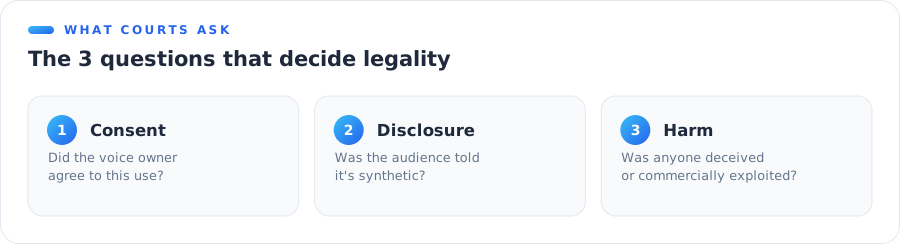 The three questions courts ask to decide legality
Legal vs illegal at a glance
| Use case | Consent? | Legal status |
|---|---|---|
| Clone your own voice for content | Your own | Legal |
| Clone an actor with a signed release | Yes | Legal |
| Dub your video into 20 languages | Your own | Legal |
| Clone a friend "as a joke," posted publicly | No | Risky / illegal |
| Impersonate a CEO to authorize a payment | No | Illegal (fraud) |
| Fake a celebrity endorsement | No | Illegal |
The 2026 EU AI Act Watermark Mandate
The single biggest change in 2026 is the EU AI Act. Its transparency obligations (Article 50) start applying from August 2, 2026.
In plain English: if you provide an AI system that generates synthetic audio, you must mark that output as artificially generated in a machine-readable way — and anyone deploying a deepfake must disclose it.
- Aug 2026 — EU AI Act transparency duties start applying (source: EU AI Act, Art. 50)
- Machine-readable — Required format for marking AI-generated audio (source: EU AI Act, Art. 50(2))
What the Act actually requires
Two duties matter for voice cloning:
- Providers of generative systems must mark synthetic audio so machines can detect it (think embedded watermarks or metadata).
- Deployers who publish deepfakes must clearly disclose that the content is artificially generated.
Machine-readable marking vs audible disclosure
These are different jobs. A machine-readable watermark lets platforms and detectors flag the audio automatically. An audible or written disclosure tells a human listener. Serious use cases increasingly do both.
What the watermark rule means for creators
If you publish AI-cloned audio to EU listeners, the safest path is simple: use a tool that watermarks output by default, so compliance isn't something you have to remember on every export.
The same goes for disclosure. Build a short "AI-generated voice" line into your publishing template once, and you stop relying on memory at the exact moment it's easiest to forget.
Built-in by design: AnyVoice watermarks every generation and records a consent step before any clone — so this obligation is handled for you rather than left as homework.
 The 2026 AI voice-cloning law landscape
Who has to comply — provider vs deployer
The Act splits responsibility. The provider (the company that builds or offers the AI system) must embed the machine-readable marking. The deployer (you, if you publish a deepfake) must add the human-facing disclosure.
If you use a hosted tool like AnyVoice, the provider duty sits with the platform — but the disclosure duty still travels with whoever hits "publish."
What happens if you ignore it
These aren't toothless guidelines. Breaching the AI Act's obligations can bring fines that reach up to €15 million or 3% of global annual turnover, whichever is higher. Transparency is cheaper than the alternative.
When the rules kick in
The AI Act entered into force in 2024 and phases in over several years. The transparency duties that touch voice cloning — machine-readable marking and deepfake disclosure — are the ones landing in August 2026. That's why this is a 2026 story, not a future hypothetical.
US Laws: The NO FAKES Act & State Rules
The United States has no single federal voice-cloning statute yet, but four threads matter in 2026.
1. The NO FAKES Act (federal, proposed)
The NO FAKES Act would create a federal right against unauthorized AI-generated replicas of a person's voice or likeness. As of 2026 it is still a proposed bill — powerful signal of direction, not yet law.
2. The ELVIS Act (Tennessee)
Tennessee's ELVIS Act is already in force and is notable for one reason: it explicitly names voice as a protected personal right against unauthorized AI cloning.
3. State right-of-publicity laws
States like California, New York, and Illinois apply existing right-of-publicity and biometric laws to synthetic voices. California's statute, for example, has long protected against unauthorized commercial use of a person's voice.
4. The FTC impersonation rule
The Federal Trade Commission has finalized rules targeting the impersonation of businesses and government, and has moved to extend protection to the impersonation of individuals — directly relevant to voice-cloning scams.
5. California's digital-replica laws
California went furthest in 2024. AB 2602 makes contracts unenforceable if they let a company use a performer's AI "digital replica" without specific, informed consent. AB 1836 protects deceased performers, requiring estate consent for digital replicas.
On top of that, California's long-standing right of publicity (Civil Code §3344) already protects a person's voice from unauthorized commercial use.
6. Illinois and biometric law (BIPA)
Illinois treats a voiceprint as a biometric identifier under BIPA. Collecting or using it without written consent can trigger statutory damages per violation — which is why voice data handling matters, not just the output.
UK, Canada & the Rest of the World
Voice-cloning law is a patchwork. Here's the quick global picture.
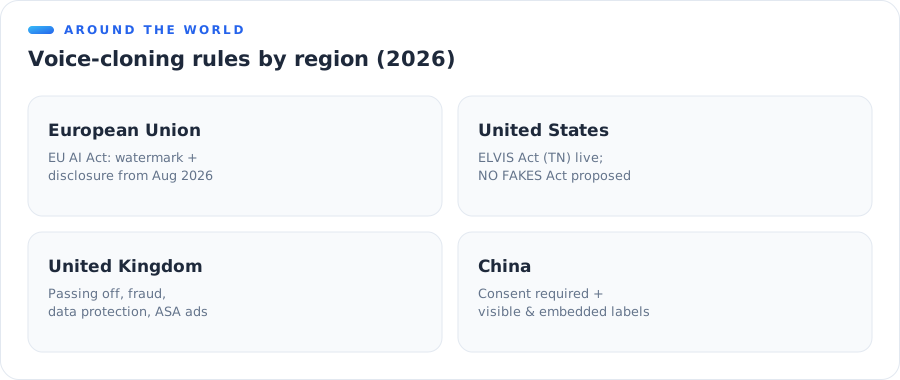 Voice-cloning rules by region in 2026
United Kingdom
The UK has no dedicated voice-cloning law, but several existing routes apply: passing off, fraud, data protection (a cloned voice can be personal data), and defamation if the clone is used to put false words in someone's mouth.
Advertising rules add another layer. The ASA can act against ads that use a synthetic voice to imply an endorsement that never happened, and parts of the Online Safety regime reach the most harmful deepfakes.
China
China is one of the strictest. Its deep-synthesis rules require the consent of the person whose voice is synthesized, and its 2025 content-labeling measures require AI-generated audio to carry both visible and embedded labels.
Canada, Australia & beyond
Canada and Australia lean on privacy, consumer-protection, and publicity-style rights. Some countries are going further still — Denmark has proposed giving people a copyright-style right over their own voice and features.
Rule of thumb
Wherever you operate, consent plus disclosure keeps you compliant almost everywhere. It's the one habit that travels across all these jurisdictions.
When Does AI Voice Cloning Become Illegal?
Cloning crosses the line the moment it's used to deceive or exploit. Here are the four situations that get people into real trouble.
Impersonation and fraud
Using a cloned voice to impersonate a real person — a bank, a boss, a family member — to obtain money or data is fraud. So-called "grandparent scams" and CEO-payment scams now weaponize cloned voices, and prosecutors treat them as the crimes they are.
- $2.7B — Lost to imposter scams in the US in 2023 — cloned voices are a fast-growing vector (source: US FTC, 2023)
- 3 sec — Of audio can be enough for a convincing clone — which is why disclosure laws are tightening (source: industry research, 2024)
The pattern is grimly consistent: a caller uses a few seconds of a relative's voice — often scraped from social media — to fake a distress call and demand an urgent transfer. Because the voice sounds real, victims skip the checks they'd normally make. That realism is exactly what the new disclosure and watermarking laws are trying to counter.
Non-consensual deepfakes
Generating audio that puts words in a real person's mouth without consent can trigger defamation, harassment, and emerging deepfake statutes — especially for sexual, political, or reputational content.
Fake endorsements and passing off
Making it sound like a public figure endorses your product is a textbook right-of-publicity and false-advertising violation, even if you add a tiny disclaimer.
Copyright vs the voice itself
This one's subtle, so it gets its own note.
Cloning a voice ≠ copying a recording
Copyright protects a specific recording or song, not the timbre of a voice. So a clone usually isn't "copyright infringement" — but it can still violate publicity, privacy, and unfair-competition law. Different door, same room.
Example: cloning a singer's tone to make a brand-new track usually won't infringe the copyright in their old records — but marketing it as "the real artist" can still breach publicity and false-advertising law. The recording is safe; the identity is not.
Do You Need Consent to Clone a Voice?
Almost always, yes. The exception is your own voice.
Cloning your own voice
If it's your voice, you're the rights holder. Clone away — for narration, dubbing, accessibility, or a personal voice assistant.
Cloning someone else's voice
You need their informed, written consent for the specific use. A vague "sure, go ahead" text won't protect you if the use later expands or the relationship sours.
What a voice consent form should include
- The identity of the person and the rights holder.
- The specific uses permitted (and any that are excluded).
- Duration and territory of the license.
- Whether the voice may be used for commercial purposes.
- Revocation terms and how data is deleted.
- A statement that output will be watermarked and disclosed.
AI Voice Cloning Rules by Use Case
The same law lands differently depending on who you are. Here's the practical version.
Creators and YouTubers
Cloning your own voice to narrate videos or dub them into other languages is fully legal. The catch is platform policy: YouTube and others now require you to disclose realistic synthetic or altered audio, separate from any legal duty.
Businesses and brands
If you clone a voice actor for ads or IVR, get a written release that covers the exact media, duration, and territory. Endorsement and false-advertising rules also apply — a synthetic spokesperson still has to tell the truth.
Agencies and freelancers
When you clone on behalf of a client, spell out who owns the voice model, whether it can be sublicensed, and who indemnifies whom if consent turns out to be defective. Put it in the contract, not the group chat.
What to Do If Someone Clones Your Voice Without Consent
If your voice has been cloned and misused, you have more options than you might think. Move quickly.
- Save the evidence — download the audio, links, and dates before they disappear.
- Report it to the platform — most now have dedicated synthetic-media and impersonation reporting flows.
- Report fraud — in the US, file with the FTC and, if money was involved, the FBI's IC3.
- Send a cease-and-desist — often enough to stop commercial misuse fast.
- Consider a claim — right of publicity, defamation, or a biometric-privacy claim depending on your state or country.
How to Clone Voices Legally: A 2026 Compliance Checklist
Print this. If you can tick all six, you're on solid ground in nearly every market. None of it is complicated — it's mostly about doing on purpose what most legal trouble comes from skipping.
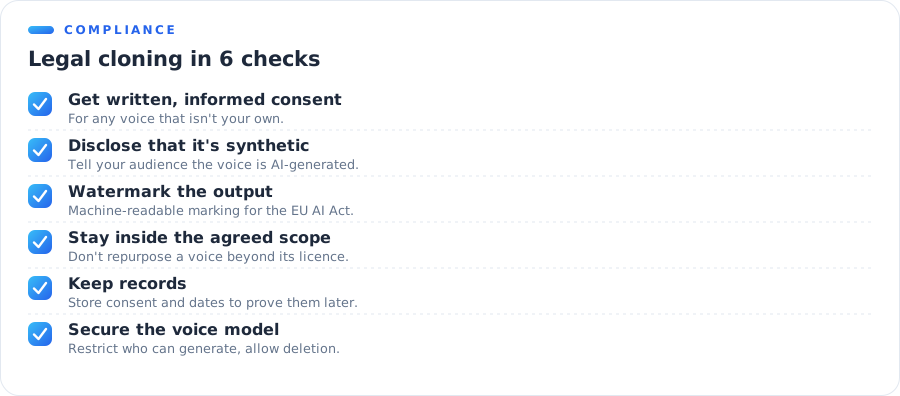 The 6-point legal cloning checklist
The 6-point legal cloning checklist
Consent · disclosure · watermark · scope · records · security
- Get written, informed consent — For any voice that isn't your own — covering the specific use.
- Disclose that it's synthetic — Tell your audience the voice is AI-generated.
- Watermark the output — Machine-readable marking to satisfy the EU AI Act.
- Stay inside the agreed scope — Don't repurpose a voice beyond what was licensed.
- Keep records — Store consent and dates in case you ever need to prove them.
- Secure the voice model — Restrict who can generate with it, and allow deletion on request.
Red flags that put you at risk
- Cloning a voice from audio you scraped online "because it was public."
- Skipping disclosure because it feels awkward.
- Relying on a verbal OK for a commercial campaign.
- Using a tool with no watermarking for EU-facing content.
How AnyVoice Keeps You Compliant
Compliance shouldn't depend on remembering six steps every time. AnyVoice bakes the important ones into the product.
Consent capture by design
Before you can build a voice, AnyVoice requires you to confirm you own the rights — and it records that consent with a timestamp. No consent, no clone.
Watermarked output by default
Every generation is watermarked, so audio you publish to EU listeners already meets the machine-readable marking expectation — without an extra step.
Control and deletion on request
Compliance also means being able to walk it back. Voice models stay private to your account, and you can delete a voice and its data when a consent agreement ends — the practical side of the "revocation" and "security" boxes on the checklist above.
Clone your voice — free — 15-second sample · watermarked output · consent-based by design. Start free →
Frequently Asked Questions
Is AI voice cloning legal?
Yes. Cloning a voice is legal when you clone your own voice or have the owner's consent. It becomes illegal when used to impersonate, defraud, or mislead people without permission.
Is it legal to clone a celebrity's voice?
No — not without their permission. Celebrities are protected by right-of-publicity laws, and unauthorized commercial use (like a fake endorsement) can lead to significant liability.
Do I need written consent to clone someone's voice?
For any voice that isn't your own, written, informed consent is strongly recommended and increasingly required under 2026 laws such as Tennessee's ELVIS Act.
Does the EU AI Act require watermarking AI voices?
Yes. From August 2026, providers must mark AI-generated audio in a machine-readable way, and deployers must disclose deepfakes. Using a tool that watermarks by default keeps you covered.
Is cloning my own voice legal?
Absolutely. Your voice is yours to use. Cloning it for narration, dubbing, or accessibility is fully legal.
Can I be sued for a voice deepfake made "as a joke"?
Potentially yes. Even non-commercial clones can trigger defamation, harassment, or privacy claims if they harm someone or are published without consent.
Is it legal to clone the voice of someone who has died?
Often no — not without the estate's permission. States like California and New York extend voice and likeness rights to deceased performers, so their heirs control commercial use.
Do I have to tell listeners a voice is AI-generated?
Increasingly, yes. The EU AI Act requires deepfake disclosure from August 2026, and major platforms require you to label realistic synthetic audio regardless of local law.
Note: This article is for general information and is not legal advice. Voice-cloning law changes quickly and varies by country and state. For a specific situation, consult a qualified attorney.