AI voice cloning works by turning a voice sample into a neural "voice model," then using that model to convert text into speech. Here's the whole pipeline, in plain English.
How Does AI Voice Cloning Work? The Short Answer
AI voice cloning works by analyzing a short voice sample to build a neural voice model, which then converts any text you type into speech that sounds like the original speaker.
That's the whole idea in one sentence. Everything else is detail about how each part happens — and the detail is genuinely interesting once you see the pipeline.
Under the surface, three things cooperate: a part that listens to your sample, a part that learns the voice, and a part that speaks new text. Modern systems do all three with deep neural networks, which is why the results jumped in quality over the last two years.
You don't need to be an engineer to follow along. Understanding the pipeline is genuinely useful, though — it tells you why a clone sometimes sounds off, and exactly which knob to turn to fix it.
The one-line version
Listen → learn → speak. A voice sample becomes a mathematical "voiceprint," and a text-to-speech model uses that voiceprint to speak anything in the target voice.
The three-part pipeline at a glance
Almost every voice-cloning system, from research demos to products like AnyVoice, follows the same shape:
- A speaker encoder — turns your sample into a compact voiceprint.
- An acoustic model — predicts how the text should sound in that voice.
- A vocoder — converts that prediction into an actual audio waveform.
Keep those three names in mind. The rest of this guide walks through them in order.
Step 1: Capturing the Voice Sample
Everything starts with audio. You record or upload a short clip of the target voice — often just 15 to 30 seconds — and that clip becomes the raw material the system learns from.
This step feels trivial, but it quietly decides most of the final quality. A clean sample gives the model a clear signal; a noisy one forces it to guess.
Why sample quality beats quantity
It's tempting to think more audio is always better. It usually isn't. A short, clean recording beats a long, noisy one because the model isn't distracted by background hum, echo, or a second person talking.
What the system wants is a representative sample: you, speaking naturally, in a quiet space. Thirty focused seconds can outperform ten messy minutes.
What the model actually listens for
During this step, the system isn't memorizing your words. It's measuring the acoustic features that make your voice yours:
- Pitch — how high or low your voice sits, and how it moves.
- Timbre — the unique tonal "color" produced by your vocal tract.
- Prosody — your rhythm, stress, and intonation patterns.
What counts as a "clean" sample
In practice, clean means three things: no background noise, no music or second voice, and no heavy compression. A quiet room and a phone held close will beat a good mic in an echoey space. Record a few natural sentences rather than reading stiffly — the model copies your energy, so give it energy worth copying.
The role of the speaker embedding
The speaker encoder compresses all of that into a speaker embedding — a short list of numbers (a vector) that represents your voice. Think of it as a fingerprint: small, unique, and enough to identify the voice later. This embedding is the thing that gets reused every time you generate speech.
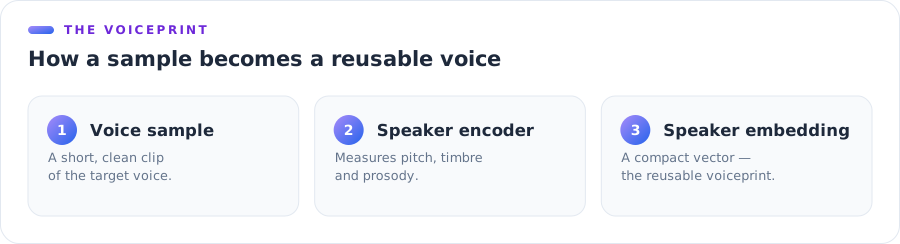 From voice sample to reusable voiceprint
Step 2: Building the Voice Model (Training)
Once the system has your voiceprint, it needs to connect that identity to the mechanics of speech. This is the "model" in voice model.
What a neural network learns
The core model has already been trained on thousands of hours of speech from many people. From that, it learned the general relationship between text and sound — how letters become phonemes, how phonemes become audio.
Your speaker embedding then steers that general knowledge toward your specific voice. The model doesn't relearn English from scratch; it just re-colors its output to match you.
Zero-shot vs fine-tuned training
There are two ways to do this, and the difference explains why some clones are instant and others take longer.
Zero-shot cloning
Zero-shot models take your embedding and generate speech immediately, without additional training. This is what makes 15-second, browser-based cloning possible. It's fast and, in 2026, remarkably good.
Fine-tuned cloning
Fine-tuning actually adjusts the model's internal weights using more of your audio. It takes longer and needs more data, but it captures the last few percent of fidelity — the kind studios and audiobook publishers care about.
For almost everyone, zero-shot is the right call in 2026. The quality gap has shrunk to the point where most listeners can't tell, and you save the time and cost of a full fine-tune.
| Approach | Audio needed | Speed | Best for |
|---|---|---|---|
| Zero-shot | 15–30 sec | Seconds | Creators, everyday use |
| Fine-tuned | Minutes–hours | Minutes+ | Studios, audiobooks |
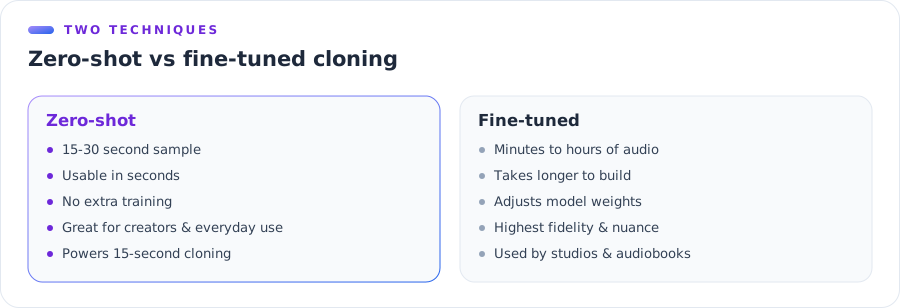 Zero-shot vs fine-tuned cloning
Step 3: Turning Text Into Speech
Now the fun part. You type a sentence, and the model produces audio in the cloned voice. This happens in three sub-steps, shown below.
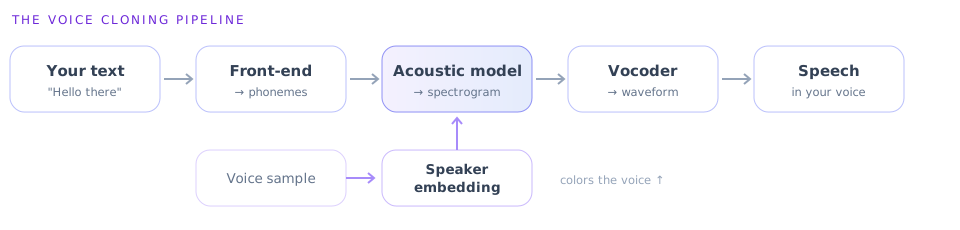 From text to a waveform in the cloned voice
Text becomes phonemes (the front-end)
First, a front-end normalizes your text and converts it into phonemes — the basic sound units of speech. It decides that "2026" is spoken "twenty twenty-six," and that "read" sounds different in "I read books" versus "I read it yesterday."
Handling the tricky bits of text
This front-end quietly does a lot of work. It expands numbers, dates, and abbreviations, guesses the right pronunciation for names, and uses surrounding words to resolve homographs — words spelled the same but said differently. When a clone mangles a name, this is usually the stage that slipped.
Phonemes become a spectrogram (the acoustic model)
Next, the acoustic model predicts how those phonemes should sound — in your voice. It outputs a mel-spectrogram, a picture of sound over time that captures pitch and timbre. This is the step your speaker embedding steers.
Think of the acoustic model as a narrator who has read the script and knows exactly how it should be performed — but hasn't opened their mouth yet. The performance is planned; the sound comes next.
The spectrogram becomes audio (the vocoder)
Finally, a vocoder turns that spectrogram into an actual waveform you can hear. Modern neural vocoders do this fast enough to feel near-instant, which is why generation takes seconds rather than minutes.
If the acoustic model is the narrator planning the performance, the vocoder is the voice box that actually produces the sound. Only after this stage does silent prediction become audio you can play and download.
The Technology Behind It
The pipeline above is the "what." Here's a little of the "why it works now," without the math.
From robotic to neural
Older text-to-speech stitched together tiny prerecorded audio clips. It worked, but it sounded flat and couldn't imitate a specific person. That era is why so many people still assume synthetic voices sound robotic.
A second era, "parametric" TTS, tried to model speech with statistics. It was more flexible but sounded buzzy and artificial — better plumbing, still not human.
Neural TTS changed everything. Instead of gluing clips together, it generates audio from scratch, which lets it bend the output toward any voice. This is the shift that made voice cloning, not just voice synthesis, possible.
Transformers and diffusion
Today's best systems use the same families of models powering the wider AI boom — transformers and diffusion models. They're extremely good at modeling sequences and fine detail, which is exactly what natural speech needs.
Some engines even treat speech like a language, predicting audio "tokens" the way a chatbot predicts words. Different recipe, same goal: audio that flows naturally instead of stitching together.
Why 2026 models feel instant
The big unlock was zero-shot cloning: models trained so broadly that they can imitate a brand-new voice from one short sample, with no extra training. That's the difference between "upload and wait an hour" and "upload and hear it in seconds."
All the expensive computing happened once, up front, when the base model studied thousands of hours of speech. Your clone rides on top of that investment — which is why it feels free and instant to you.
How Cloning Preserves Emotion and Accent
A good clone isn't just the right pitch. It carries the feel of a voice — and increasingly, it can carry it across languages.
Prosody modeling
Prosody is the melody of speech: where you pause, what you emphasize, how you rise at a question. Modern acoustic models predict prosody explicitly, which is why 2026 clones sound expressive rather than monotone.
It's also the hardest part to fake. Get prosody wrong and even a perfectly matched timbre sounds robotic; get it right and a clone crosses into genuinely lifelike territory.
Cross-lingual cloning
Because the voiceprint is separate from the language model, a strong engine can make your cloned voice speak languages you don't — while keeping your timbre. That's how one creator can localize a video into 80+ languages and still sound like themselves.
Emotion and style control
Newer engines let you nudge the delivery, not just the words. You can ask for a calmer, faster, or more upbeat read, and the acoustic model shifts its prosody to match. It's the difference between a voice that reads text and one that performs it — though extreme, theatrical emotion is still where human actors keep the lead.
Why it matters
Separating voice from language is the trick behind multilingual cloning. Your identity is one file; the words are another. Swap the words, keep the voice.
Why AI Voice Clones Sometimes Sound Off
When a clone disappoints, it's rarely random. Almost always, one part of the pipeline was starved of good input. Here's how to read the symptoms.
Too little — or too much — sample
A sample under a few seconds gives the speaker encoder too little to work with. Oddly, a very long sample can hurt too, if it drifts across moods, rooms, or microphones.
Noisy or over-compressed audio
Background noise gets baked into the voiceprint, so the clone "learns" your air conditioner. Heavy compression strips out the high-frequency detail that makes a voice recognizable.
Unusual text and names
If the front-end mishandles an acronym, a foreign name, or odd punctuation, the acoustic model faithfully speaks the mistake. Clear phrasing gives it a clear target.
Pushing beyond ordinary speech
Singing, shouting, and heavy character voices sit outside what most engines were trained on, so results wobble. The fix is usually a cleaner sample and a tool tuned for that style.
Watermarking and Safety: How It Works
Powerful cloning needs guardrails, and they're built into the pipeline rather than bolted on afterward.
How an audio watermark is embedded
A watermark hides an inaudible signal inside the generated audio. You can't hear it, but a detector can — and it survives compression and re-uploading. From August 2026, the EU AI Act expects exactly this kind of machine-readable marking on AI-generated audio.
Watermarks pair well with provenance standards, which attach a tamper-evident record of how a file was made. Together they let platforms flag synthetic audio automatically — the technical backbone behind the new disclosure rules.
Consent records
Responsible tools also capture a consent step before building a voice, storing a timestamped record that the user had the right to clone it. Technically simple; legally essential.
Together, watermarking and consent turn cloning from a liability into a tool you can use with a clear conscience. They're not an afterthought — on a well-built platform, they're part of the same pipeline as everything above.
We go deeper on the rules in Is AI voice cloning legal?
How Long Does It Take, and What Affects Quality?
Two questions everyone asks once they understand the pipeline.
How fast is it?
With zero-shot cloning, building the voice takes seconds, and generating speech is roughly real-time. The heavy work happened long ago, when the base model was trained.
In practice, that means the slowest part of making a clone is usually you recording the sample. Once the audio is in, the pipeline runs faster than you can read the result aloud.
What affects the final quality?
Three levers matter most, and you control two of them:
- Sample quality — clean, quiet audio in, clean voice out.
- The engine — AnyVoice runs on a top-ranked cloning engine, so the baseline is high.
- Text and settings — natural phrasing and sensible speed/emotion settings help.
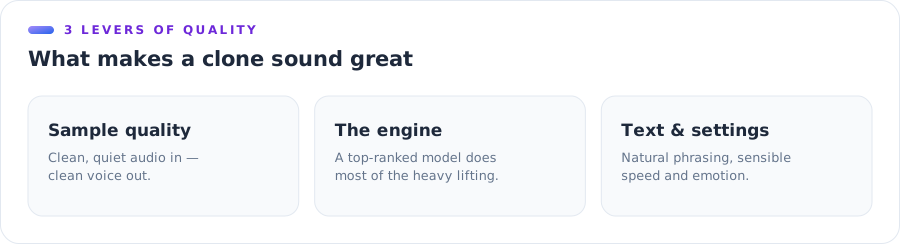 The three levers of clone quality
Notice that two of the three levers are in your hands. You can't rewrite the engine, but you fully control the sample and the text — which is exactly where most quality problems are won or lost.
- 15 sec — sample length modern zero-shot cloning needs (source: AnyVoice)
- ~Real-time — generation speed for typical text on 2026 engines (source: industry, 2026)
Key Terms, Decoded
Five words unlock almost every explanation of voice cloning. Here they are in plain English.
Speaker embedding
The compact "voiceprint" — a short list of numbers that captures what makes a voice unique. It's created once from your sample and reused for every generation.
Mel-spectrogram
A visual map of sound over time, weighted the way human hearing works. The acoustic model predicts one of these before any audio exists.
Vocoder
The component that turns a spectrogram into a real, playable waveform. It's the last step before you hear anything.
Zero-shot
Cloning a brand-new voice from one short sample with no extra training. It's why 2026 cloning feels instant.
Prosody
The rhythm, stress, and intonation of speech — the "melody" that separates expressive speech from a monotone read.
Try AI Voice Cloning Yourself
Reading about the pipeline is one thing; hearing your own voice come out of it is another. The process takes about a minute.
- Record or upload a clean 15-second sample.
- Confirm you own the voice, and let it build the model.
- Type any text and generate — then download the audio.
Hear the pipeline in action — free. Clone your voice in 15 seconds · 80+ languages · watermarked output. Start free →
Frequently Asked Questions
How does AI voice cloning work, in simple terms?
It turns a short voice sample into a numerical "voiceprint," then a text-to-speech model uses that voiceprint to speak any text in the cloned voice.
What is a speaker embedding?
It's a compact set of numbers that represents a voice's unique features. The system reuses this "voiceprint" every time it generates new speech.
Why does voice cloning need so little audio now?
Because of zero-shot models trained on huge amounts of speech. They generalize to a new voice from one short sample, with no extra training.
What is a vocoder?
The final stage of the pipeline. It converts the model's spectrogram prediction into an audible audio waveform.
Can a cloned voice speak other languages?
Yes. Because the voiceprint is separate from the language, strong engines can make your voice speak languages you don't, while keeping your tone.
Does cloning copy my original recording?
No. It builds a new voice model from your sample. The output is generated from scratch, not spliced from your recording.