AI voice regulation stopped being hypothetical this year. Global fraud losses hit $442 billion in 2025 (source: INTERPOL, Global Financial Fraud Threat Assessment, March 2026), and lawmakers responded with the busiest 18 months of voice-AI rulemaking on record.
This page is our living tracker of every rule that matters — what's in force, what's coming, and what it means if you actually publish AI audio. We update it as laws change.
Here's what you'll find:
- The full 2026 timeline of AI voice laws, in one table
- What the NO FAKES Act does and how close it is to passing
- The EU AI Act watermark duty that starts August 2, 2026
- Every US state law worth knowing, at a glance
- A practical compliance checklist for creators
The State of AI Voice Regulation in 2026
In 2026, AI voice cloning is regulated on three fronts: the EU requires machine-readable watermarks on synthetic audio from August 2, the US is advancing a federal right over your voice (NO FAKES Act) on top of state laws like Tennessee's ELVIS Act, and China already mandates labels on all AI-generated audio.
That's the whole landscape in one paragraph. The rest of this tracker unpacks each piece.
The direction of travel is consistent everywhere: consent, disclosure, and traceability. No major jurisdiction is trying to ban voice cloning. Every major jurisdiction is trying to make undisclosed, non-consensual cloning expensive.
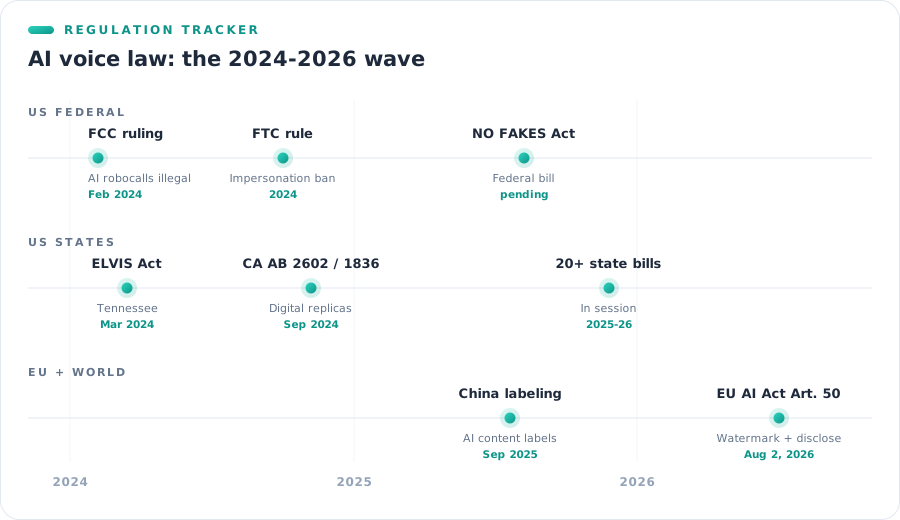 The 2026 regulation timeline: federal, state, and international lanes
The tracker: every major rule at a glance
| Rule | Jurisdiction | Status (July 2026) | Who it affects |
|---|---|---|---|
| EU AI Act, Article 50 | EU | Applies Aug 2, 2026 | Providers + anyone publishing deepfakes |
| NO FAKES Act (S.4591) | US federal | Advanced committee Jun 18, 2026 — not yet law | Everyone using a person's voice or likeness |
| FCC AI robocall ruling | US federal | In force (Feb 8, 2024) | Anyone making calls with AI voices |
| FTC impersonation rule | US federal | In force; individual-impersonation extension proposed | Scammers impersonating businesses, government, people |
| ELVIS Act | Tennessee | In force (Jul 1, 2024) | Users and tool providers |
| AB 2602 / AB 1836 | California | In force | Studios, performers, estates |
| AI Labeling Measures | China | In force (Sep 1, 2025) | All providers of synthetic audio |
How to read this tracker
Two dates matter most in 2026. August 2 (EU watermark and disclosure duties begin) and whatever day the NO FAKES Act reaches a floor vote. Everything else is already the law you're living under.
US Federal Rules
The United States still has no single federal voice-cloning statute. But three federal threads now cover most real-world abuse — and one of them is about to become much bigger.
The NO FAKES Act: closer than ever
The NO FAKES Act of 2026 (S.4591) would create a federal intellectual-property right over every American's voice and visual likeness against unauthorized AI replicas.
On June 18, 2026, the Senate Judiciary Committee advanced it unanimously by voice vote (source: Holland & Knight). A companion bill (H.R.8915) sits in the House. That's the furthest any federal voice-rights bill has ever gotten.
Three design choices stand out:
- The right is licensable but not assignable during your lifetime — you can rent your voice out, but you can't permanently sign it away.
- It survives death, so estates control a deceased person's voice.
- It has unusually broad backing: AI companies, the recording industry, labor unions, and child-safety groups all support it.
What happens if it passes
For creators, surprisingly little changes — if you already work with consent. The Act targets unauthorized replicas. Licensed voice work, self-cloning, and consented projects stay legal. What changes is that victims of non-consensual clones finally get one federal cause of action instead of a patchwork of state claims.
The FCC's AI robocall ban
This one is settled law. On February 8, 2024, the FCC ruled that AI-generated voices count as "artificial" under the Telephone Consumer Protection Act (source: FCC Declaratory Ruling).
The practical meaning is blunt: AI-voice robocalls without prior consent are illegal. The FCC can fine violators, carriers can be forced to block their traffic, and state attorneys general can sue.
The FTC impersonation rules
The Federal Trade Commission finalized its rule banning impersonation of government and businesses in 2024, and has proposed extending it to the impersonation of individuals — which would put everyday voice-clone scams squarely inside FTC enforcement.
Together, the FCC and FTC rules cover the two most common abuse patterns: mass robocalls and targeted impersonation fraud.
US State Laws
While Congress deliberates, states legislate. More than a dozen now have laws that touch synthetic voices. Four clusters matter.
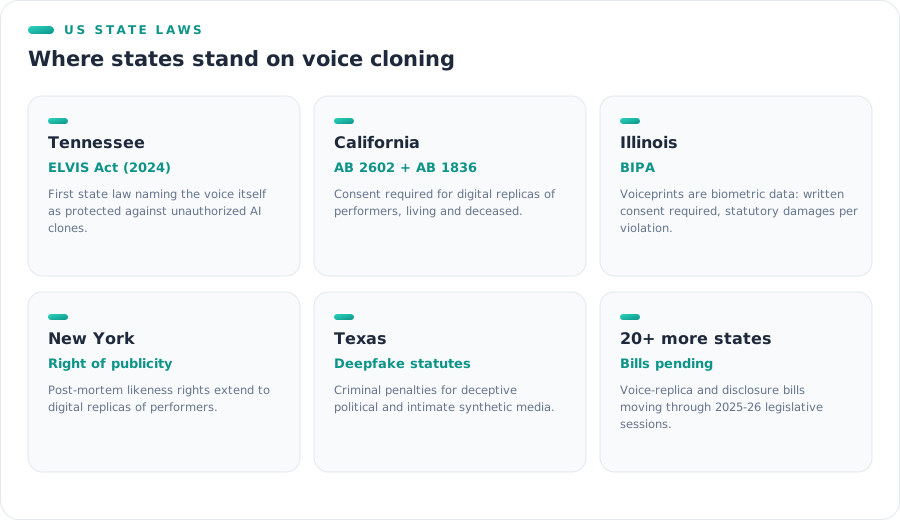 The state-law map: named voice rights, deepfake bans, and disclosure rules
Tennessee's ELVIS Act
Tennessee's Ensuring Likeness, Voice and Image Security Act — in force since July 1, 2024 — was the first US law to explicitly name voice as a protected right against unauthorized AI simulation.
Why the ELVIS Act reaches further than you'd think
Most publicity laws only punish the person who uses a fake voice. The ELVIS Act extends liability to tool providers and platforms that knowingly enable unauthorized cloning, and it carries both civil and criminal penalties. If you build or host voice tech, Tennessee is the state law to read first.
California's digital-replica duo
California passed two targeted laws that took effect in 2025:
AB 2602: consent in contracts
AB 2602 makes a contract clause unenforceable if it lets a studio use a performer's AI "digital replica" without specific, informed consent — negotiated with representation. Vague buyout language no longer covers AI replicas.
AB 1836: deceased performers
AB 1836 requires estate consent before creating digital replicas of dead performers. Combined with California's long-standing right of publicity (Civil Code §3344, with postmortem rights running 70 years), the state now protects a voice before and after death.
Other states at a glance
| Approach | States | What the law does |
|---|---|---|
| Named voice right | Tennessee | Voice is an explicit property right vs AI clones |
| Deceptive-deepfake bans | Minnesota, Michigan, Mississippi | Prohibit materially deceptive synthetic media outright |
| Disclosure mandates | Colorado, Utah, Oregon, Wisconsin | Require prominent "AI-generated" labeling |
| Biometric consent | Illinois (BIPA) | Voiceprints need written consent; statutory damages per violation |
The Illinois angle: your voice as biometric data
Illinois treats a voiceprint as a biometric identifier under BIPA. That regulates the input side of cloning — collecting and processing voice data — not just the published output. Damages accrue per violation, which is why BIPA cases settle big.
The EU AI Act: What Changes on August 2, 2026
The biggest single date on this tracker. The EU AI Act's Article 50 transparency obligations apply from August 2, 2026 (source: European Commission; artificialintelligenceact.eu).
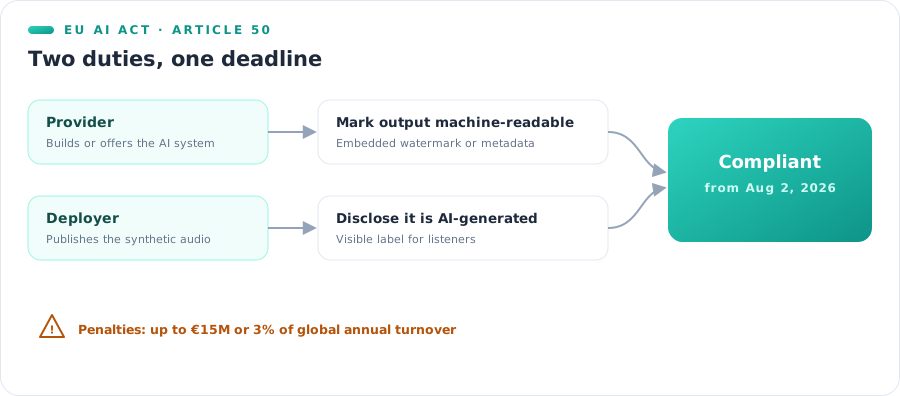 Article 50 in one picture: who must mark, who must disclose
Duty one: machine-readable marking
Providers of generative audio systems must mark output as AI-generated in a machine-readable way — via metadata, watermarking, or fingerprinting — so platforms and detectors can identify synthetic audio automatically.
One transitional detail worth knowing: under the EU's Digital Omnibus provisional agreement of May 7, 2026, providers already on the EU market before August 2 get until December 2, 2026 to bring their marking tech into conformity (source: Greenberg Traurig).
Duty two: deepfake disclosure
Deployers — anyone who publishes a deepfake — must clearly disclose that the content is artificially generated. Pending an EU-wide symbol, the interim label is a visible "AI" icon.
Note the split: the platform handles the invisible watermark; the disclosure duty travels with whoever hits publish. That's you.
What non-compliance costs
Article 50 violations carry fines up to €7.5 million or 1.5% of global annual turnover, whichever is higher. Breaches of the Act's prohibited-practice rules scale to €35 million or 7%. A one-line disclosure is dramatically cheaper.
Built-in by design: AnyVoice watermarks every generation and records a consent step before any voice is cloned — so the provider-side marking duty is handled for you, and your only homework is the human-facing disclosure line.
Rest of the World
China: labels on everything, since September 2025
China moved earliest and hardest. The Measures for Labeling AI-Generated Synthetic Content — issued by the Cyberspace Administration and three other agencies — took effect on September 1, 2025 (source: Loeb & Loeb).
Synthetic audio needs two labels:
- An explicit label users can perceive — a voice prompt or visible marker.
- An implicit metadata label carrying the provider's name and a content reference number.
The Measures build on China's 2023 Deep Synthesis Provisions, which already required consent for voice synthesis of identifiable people.
The UK: existing law, no new statute
The UK has no dedicated voice-cloning act. Protection runs through existing tools — passing off, data protection, fraud, and harassment law. Watch this space; a consultation on AI and likeness rights has been repeatedly floated, but as of July 2026 nothing specific has been enacted.
Everywhere else
Most other jurisdictions currently follow the UK pattern: apply existing publicity, privacy, and fraud law to synthetic voices, and wait to see how the EU's enforcement lands. The EU AI Act is widely expected to become the template — the same "Brussels effect" that made GDPR a global default.
Two practical consequences follow from that. If you publish globally, building to the EU standard is the safe default, because it's the strictest transparency regime you'll face. And if you're choosing tooling now, prefer tools whose marking is machine-readable rather than merely visible — that's the format both the EU and China have standardized on, and the one platforms can verify automatically.
Platform Rules: The Private Regulators
Before any government fines you, a platform will demote you. For most creators, platform policy is the regulation they actually feel day to day — and platforms moved faster than lawmakers.
YouTube
YouTube requires creators to disclose realistic synthetic media at upload, including AI-generated voices that a viewer could mistake for real. Disclosed content gets a label; undisclosed realistic synthetics risk removal and strikes. YouTube also lets people request removal of content that simulates their voice or face through its privacy complaint process.
TikTok
TikTok requires a label on any realistic AI-generated content and prohibits synthetic media of private figures without consent entirely. It auto-labels content it detects as AI-made, and it was among the first platforms to attach Content Credentials metadata — the same machine-readable marking philosophy the EU AI Act now mandates.
Podcast and music platforms
Music distributors and streaming services increasingly ask whether a track contains AI vocals at submission, and unauthorized artist-voice imitations get taken down on right-of-publicity claims. If you publish narration or audiobooks, the major marketplaces likewise require that you hold the rights to the voice you use.
Why platform rules matter more than you'd think
Two reasons. First, platforms enforce daily, while regulators enforce occasionally — a mislabeled video loses reach this week, not after a lawsuit. Second, platform policies quietly converge on the same three requirements as the laws above: consent, disclosure, traceability. Satisfy the legal checklist and you satisfy the platforms for free.
Why Regulators Are Moving: The Scam Wave
The legislative sprint has one root cause. Voice cloning became the fraud world's favorite tool.
The numbers behind the 2026 rulebook:
- $442 billion — global financial fraud losses in 2025 (INTERPOL, March 2026)
- 1,600%+ — growth in deepfake vishing attacks, Q1 2025 vs Q4 2024
- 3 seconds — audio needed to build an ~85% match clone (McAfee)
- 1 in 10 — Americans who have already encountered a voice-clone scam (McAfee, 2026)
- $680,000 — average enterprise loss per voice-fraud attack
The regulation logic
Every 2026 rule maps to a scam pattern. Robocall bans target mass fraud. Impersonation rules target targeted fraud. Watermark mandates target deniability. Understand the scams, and the laws stop looking random.
If you're wondering whether any of this makes cloning itself illegal — it doesn't. We covered the underlying legality question in depth in our guide to is AI voice cloning legal; the short answer is that consent remains the dividing line everywhere.
What This Means for Creators
If you make content with AI voices — narration, dubbing, characters, accessibility audio — the 2026 rulebook compresses into four habits.
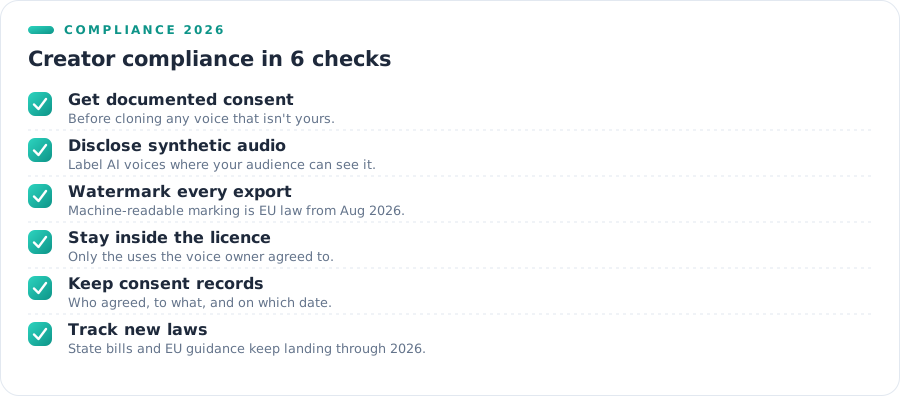 The four habits that keep you compliant in every jurisdiction
Your 2026 compliance checklist
- Clone with consent. Your own voice, always fine. Anyone else's: written, informed consent that covers the specific use. (New here? Start with what AI voice cloning is and how consent fits in.)
- Disclose synthetic audio. A short "this voice is AI-generated" line satisfies the EU deployer duty, the US disclosure states, and every major platform policy at once.
- Watermark by default. Pick a tool that embeds machine-readable marking automatically, so Article 50 compliance isn't a manual step you can forget.
- Keep records. Store consent forms, dates, and scope. Under BIPA and the ELVIS Act, being able to prove consent is worth as much as having it.
The one-sentence version
Consent in, disclosure out, watermark always, receipts forever. Do that, and every law on this tracker is already satisfied — in the EU, the US, China, and on every major platform in between. No rule currently in force asks creators for anything more than those four habits.
FAQ: AI Voice Regulation in 2026
Is AI voice cloning illegal in the US in 2026?
No — cloning itself is legal with consent. What's illegal is deceptive use: AI-voice robocalls without consent (FCC, Feb 2024), impersonating businesses or government (FTC rule), and unauthorized commercial clones in states like Tennessee under the ELVIS Act.
What is the NO FAKES Act, and has it passed?
The NO FAKES Act of 2026 (S.4591) would create a federal property right over your voice and likeness against unauthorized AI replicas. The Senate Judiciary Committee advanced it unanimously on June 18, 2026, but as of July 2026 it is not yet law.
When does the EU AI Act start applying to AI voices?
August 2, 2026. From that date, providers must mark AI-generated audio in a machine-readable way, and anyone publishing a deepfake must disclose it. Pre-existing providers have until December 2, 2026 to conform their marking tech.
What are the penalties for breaking the EU AI Act's transparency rules?
Fines for Article 50 transparency violations reach up to €7.5 million or 1.5% of global annual turnover, whichever is higher.
Which US states have AI voice cloning laws?
Tennessee (ELVIS Act), California (AB 2602, AB 1836), Minnesota, Michigan, and Mississippi (deceptive-deepfake bans), Colorado, Utah, Oregon, and Wisconsin (disclosure mandates), and Illinois (voiceprints under BIPA).
Do I have to label AI-generated audio in China?
Yes. China's Labeling Measures took effect September 1, 2025 and require both an explicit, user-perceivable label and an implicit metadata label on synthetic audio.
Are AI voice robocalls illegal?
In the US, yes — without prior consent. The FCC's February 8, 2024 ruling classified AI voices as "artificial" under the TCPA.
How do creators stay compliant with AI voice laws in 2026?
Clone only with consent, disclose AI-generated audio, use a tool that watermarks by default, and keep consent records. The checklist above walks through each step.
Keep This Page Bookmarked
Voice-AI law is moving faster than any content niche we track. The NO FAKES Act could reach a floor vote this session; the EU's transparency Code of Practice keeps evolving; more states join the list every quarter. We update this tracker as each rule lands.
Want the foundation first? Read what is AI voice cloning for the technology, and is AI voice cloning legal for the consent framework these laws are built on.
And if you'd rather your tooling handle compliance for you — consent capture and watermarking are built into every AnyVoice plan, including the free one.
Last updated: July 23, 2026. This tracker is informational, not legal advice — for specific situations, talk to a lawyer licensed in your jurisdiction.