ElevenLabs makes some of the best AI voices in the world. It also makes some of the most-searched frustration queries in the category: credit limits, character caps, surprise costs when a model re-render eats your allowance.
If that's why you're here, this comparison is built for you. We put nine alternatives through the same script, priced the same monthly workload on each, and matched every tool to the specific reason you'd leave.
What you'll learn:
- The three limits that actually push people off ElevenLabs
- 9 alternatives, each with an honest "best for" and "skip if"
- A pricing-predictability comparison the vendors won't show you
- Which tool fits your exact reason for switching
Why People Leave ElevenLabs (The Limits, Precisely)
Voice quality is rarely the reason. The reviews, forum threads, and search data point at three walls:
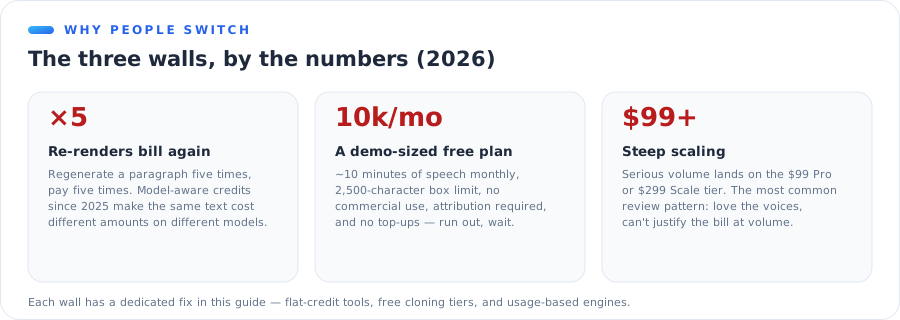
Wall 1: credits evaporate
ElevenLabs bills per character, and every re-render bills again — regenerate a flubbed paragraph five times, pay five times. Since its 2025 move to model-aware pricing, the same text also costs different credit amounts on different models, which makes budgets guesswork.
Wall 2: the free plan is a demo
As of 2026 the free tier gives 10,000 characters a month (~10 minutes), caps each generation at 2,500 characters, excludes commercial use, requires attribution, and — the kicker — can't be topped up. Run out on day 6, wait 24 days.
Wall 3: scaling price
Serious volume lands on the $99/month Pro tier or the $299 Scale tier, and long-form creators feel it fastest. The most consistent complaint pattern in public reviews is exactly this: love the voices, can't justify the bill.
If those walls sound familiar, at least one tool below removes each of them.
The 9 Best Alternatives at a Glance
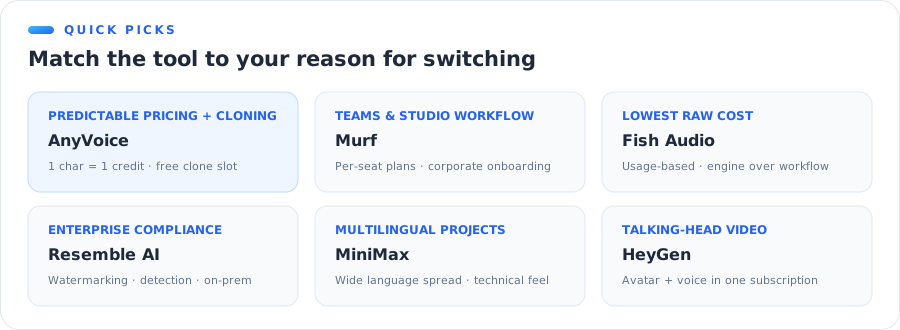
| Tool | Best for | Cloning on free? | Pricing style |
|---|---|---|---|
| AnyVoice | Predictable pricing + consent-first cloning | ✅ 1 slot | 1 char = 1 credit |
| Murf | Teams & studio workflows | ❌ | Per-seat plans |
| Fish Audio | Lowest raw cost | Limited | Usage-based |
| MiniMax | Multilingual projects | Limited | Usage-based |
| Resemble AI | Enterprise compliance | ❌ | Custom/enterprise |
| Speechify | Personal listening | ❌ | Consumer subscription |
| LOVO (Genny) | Video-centric voiceover | ❌ | Credit packs |
| Typecast | Character & content voices | ❌ | Subscription |
| HeyGen | Talking-head video | ❌ | Video-minute plans |
(One familiar name is missing on purpose — Play.ht's fate is covered below.)
How We Compared
Same method as our voice cloning software roundup: one identical script generated on each platform, one cloning attempt from the same 30-second sample where cloning exists, and each tool's pricing page translated into "what does a 100,000-character month actually cost." No affiliate links, and yes — AnyVoice is our product. We've kept the criteria measurable so you can check every claim yourself.
1. AnyVoice — Best for Predictable Pricing & Cloning Included
The direct answer to Walls 1 and 2.
Why it replaces ElevenLabs
- 1 character = 1 credit, always. No model multipliers on standard voices, no billing surprises — a 3,000-character script costs 3,000 credits every time.
- Cloning on the free plan: one clone slot plus 5,000 welcome credits, no card required. ElevenLabs' free tier gives you stock voices only, non-commercially.
- Consent-first by design: every clone requires a recorded rights confirmation, and output is watermarked — the compliance posture that 2026 regulations (EU AI Act synthetic-audio marking) now expect.
- Paid plans start at $9.99/month with clear credit allowances, scaling to agency tiers.
Where ElevenLabs still wins
Sound-effects generation, conversational-agent infrastructure, and the sheer breadth of its voice marketplace. If you need those specifically, you may end up with both.
📖 Full head-to-head: AnyVoice vs ElevenLabs covers voice quality, pricing math, and safety side by side.
2. Murf — Best for Teams
Murf's pitch is workflow, not just voices: a studio editor with per-slide/per-block voiceover, team seats, and the most corporate-friendly onboarding in the category. Voice quality sits a notch below ElevenLabs' top models but comfortably above "fine." Pricing is per-seat subscription — predictable for teams, overkill for solo creators.
Skip if: you're an individual optimizing cost per character.
3. Fish Audio — Best Raw Cost
The budget answer. Fish Audio's usage-based pricing undercuts nearly everyone on straight cost per character, and its cloning is fast from short samples. The trade-offs: a thinner editing interface and fewer guardrails — you're buying an engine more than a workflow.
Skip if: you want polished tooling, team features, or hand-holding.
4. MiniMax — Best Multilingual Spread
MiniMax's voice models punch hard across Asian and European languages, making it the pick when your content ships in many locales at once. Interface and docs assume some technical comfort.
Skip if: you publish only in English — simpler tools serve you better.
5. Resemble AI — Best for Compliance-Heavy Enterprise
Resemble has repositioned around security: watermarking, deepfake detection, consent verification, on-prem options. If your legal team asks questions like "where is the training audio stored," this is the shortlist. Pricing is enterprise-shaped accordingly.
Skip if: you're a creator — you'd be paying for auditors you don't have.
6. Speechify — Best for Listening, Not Producing
Speechify is a consumer reading app first: it excels at turning articles, PDFs, and docs into audio for you to hear. Production features (export workflows, fine control) trail the production-first tools here.
Skip if: the audio is for an audience rather than your own ears.
7. LOVO (Genny) — Best Video-Centric Workflow
LOVO bundles TTS with a video editor and subtitle tools, targeting the "voiceover + captions in one place" crowd. Voice list is broad; the best voices are gated to higher tiers.
Skip if: you already live in CapCut or Premiere — then a generate-and-import workflow beats an all-in-one.
8. Typecast — Best for Character Delivery
Typecast leans into expressive, character-style voices — shouting, whispering, crying — aimed at story content and skits. Less suited to neutral narration at length.
Skip if: you need one consistent professional narrator for hours of audio.
9. HeyGen — Best When Voice Is Half the Job
HeyGen is a talking-avatar video platform with voice cloning inside. If your end product is a person on screen, it collapses two tools into one; if you only need audio, you're paying for video minutes you won't use.
Skip if: audio-only. That's most readers of this page.
A Note on Play.ht
Play.ht appears in older "alternatives" lists everywhere — and its site is still online — but the company was acquired by Meta in mid-2025, and the product and API have been wound down. Treat any current recommendation of it as a sign the list you're reading hasn't been updated.
"What About the Dialogue Feature?"
A newer wave of switch-searches comes from ElevenLabs' multi-speaker dialogue tools — users hitting the ceiling on how many dialogue turns or credits a project allows, then discovering the limits are plan-shaped, not technical.
Two honest notes if that's you:
- No alternative replicates the exact feature. Multi-speaker dialogue generation in one box is genuinely an ElevenLabs strength today.
- Most dialogue workloads don't need it. The pattern that works everywhere: generate each speaker's lines separately — one voice per character, one file per turn — and assemble in your editor. It's ten extra minutes, it removes the turn limits entirely, and it gives per-line regeneration instead of re-rendering whole scenes. With voice cloning, the characters can even be you.
If dialogue-in-one-box is non-negotiable, stay on ElevenLabs for that workload and route your narration volume — where the credits actually burn — to a flat-priced tool. Split stacks are normal now.
Migrating Off ElevenLabs: The 20-Minute Checklist
Voices don't transfer between platforms — but almost everything else about a clean migration is preparation:
- Re-clone at the source. Don't feed ElevenLabs output into a new tool as a cloning sample; use your original recordings. Quality clones come from clean human audio, and consent confirmations must reference the real speaker anyway.
- Bring your pronunciation list. Every platform mangles different words. Keep the list of names and terms you'd taught yourself to spell phonetically — you'll re-apply it in week one.
- Parallel-run one real project. Generate last week's actual script on the new tool before canceling anything. Marketing samples are cherry-picked; your script is the test.
- Mind the renewal date. Billing complaints around auto-renewal and cancellation timing are among the most common in public ElevenLabs reviews — cancel after confirming the switch works, but before the next cycle bills.
- Re-verify commercial rights. Your old plan's grant doesn't follow you. Confirm the new tool's commercial terms in writing (the pricing page counts) before shipping client work.
Pricing Predictability: The Comparison That Matters
The spec sheets compare voice counts. The thing that actually determines your bill is whether the same work costs the same amount every month:
| Tool | Billing unit | Same text = same cost? | Re-render penalty |
|---|---|---|---|
| ElevenLabs | Model-aware credits | ❌ varies by model | Full price each time |
| AnyVoice | 1 char = 1 credit | ✅ always | Standard rate, no multiplier |
| Murf | Seat + time | ✅ (flat sub) | None within plan |
| Fish Audio | Usage | ✅ | Charged per use |
| LOVO | Credit packs | Mostly | Charged per use |
Two habits cut costs on any per-character platform: proof your script before generating (silent typos are the most expensive kind), and generate long content in paragraph-sized blocks so a fix never means re-rendering the whole piece.
How to Choose (30-Second Decision)
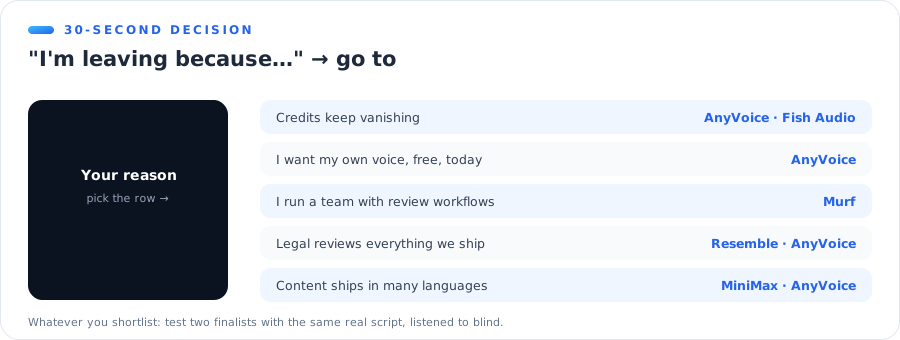
- "Credits keep vanishing" → AnyVoice (flat credits) or Fish Audio (cheapest raw usage).
- "I need my own voice, free, today" → AnyVoice free cloning — the only free clone slot on this list.
- "I run a team" → Murf.
- "Legal reviews everything" → Resemble AI, or AnyVoice for consent + watermarking without enterprise pricing.
- "Multilingual everything" → MiniMax, with AnyVoice as the simpler runner-up.
- "It's for videos with faces" → HeyGen.
Whatever you choose, run the same test we did: one real script from your actual work, generated on two finalists, listened to blind. Marketing pages all sound identical; your script won't.
Do You Even Have to Pick One?
A quietly common endgame: keep both. The economics work because the tools' strengths don't overlap where the money burns.
The pattern we see most: ElevenLabs' free or Starter tier stays in the stack for its marketplace voices and dialogue tooling — the low-volume, high-uniqueness work — while daily narration volume (the thousands of characters that actually drain credits) moves to a flat-priced tool. Your monthly bill drops because the volume moved, not because you compromised.
The reverse split also exists: AnyVoice free plan for your cloned voice, stock work wherever you already pay. Free tiers are permission to be promiscuous — the only real mistake is paying twice for the same job.
The Bottom Line
ElevenLabs remains excellent — and its limits remain real. The good news is that "alternative" no longer means "downgrade": predictable-pricing tools now match it for everyday narration quality, and several beat it outright on cloning access, compliance posture, or cost.
Start where the walls hurt most, test with your own script, and keep the receipts on commercial rights.
Try the switch in five minutes. Clone your voice free — one slot, 5,000 welcome credits, no card, watermark-protected. Start with AnyVoice free voice cloning →